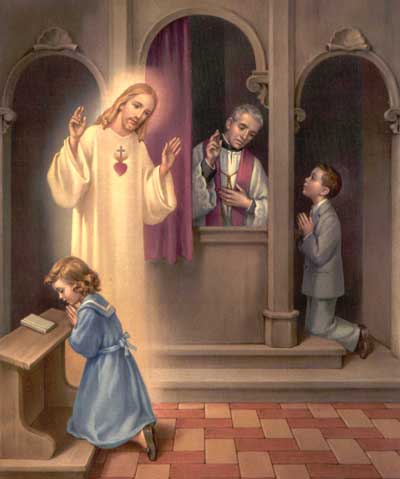
If the Eucharist is the most important Sacrament of the Church, than Reconciliation is perhaps its most misunderstood. It is sparingly used, with some relatively faithful Catholics going as little as once every few years, and is often refuted as an incredible invasion of privacy by the Church. "Why must I confess my sins to a priest? Why can't I go straight to Christ for forgiveness?" is often the inquisition of the skeptic towards Confession. However, the Sacrament of Reconciliation is one of the most beautiful in the Church, and among the most needed Sacraments in our world today.
Where'd it come from?
Well, it has loose ties to the call for repentance by John the Baptist, but those are (as I said) loose. However, it has much stronger ties to Christ's sending forth of his disciples in John 20:19-23, when Christ says "Peace be with you. As the Father has sent me, so I send you . . . Receive the Holy Spirit. Whose sins you forgive are forgiven them, and whose sins you retain they are retained." There are two things that must be mentioned about this Scriptural Text.
The First is this, before Christ no one had the ability to forgive sin except for God alone. The only way a person could have any relative certainty about his/her forgiveness was through a formal and appropriate sacrifice, according to the Law (or תורה in Hebrew). When Christ forgives the sins of others, it is extremely controversial because in doing so He claims a certain authority that belongs to God alone. In fact his ability to forgive sins, proved outright in the Gospels by his ability to perform miracles along with it such as in Matthew 9:5-7, is evidence for Christ's divinity. So the ability to forgive sins is an action of divine competence.
The Second is that Christ's specific command in John 20:19-23 is expressly given to the Twelve (or at least 10 of the 12, not including Judas, and Thomas who had not come yet). He did not issue it to his disciples or even to Mary, His Holy mother. This was given particularly to the Twelve disciples and vicariously through their successors. In Christ's handing on of this authority, he does not remove the divine authority required to forgive sins, but rather relinquishes that divine authority to a chosen few (this is somewhat comparable to the relinquishing of the ability to forgive sins through sacrifice to the Levites). So the answer to the common question "Can't I just go directly to God for the forgiveness of my sins?" would be "No. You do not have the authority."
What it does?
The short answer is that it absolves you of your sins, assuming the priest chooses to forgive them. He could choose to retain them, in which case you'd be screwed. However if your sins are indeed forgiven, then you not only receive forgiveness, but you also receive many graces along with it. One of which, that I have particularly come to appreciate, is a greater spiritual awareness of one's sinful condition and the connection between severe sins and "lesser" sins. Regular attendance to this Sacrament allows one to remove grave sin from their life, by being able to focus on the "lesser" sins which lead up to it. For example, someone who perhaps has a strong difficulty with lust, such as pornography, may (through regular confession) be able to recognize its connection to acts of selfishness, imprudent speech, or forgetfulness of the poor and lack of charity. Through their recognition and correction of these sins, they can uproot the weeds which poison the garden of their souls and lead to grave sin. In doing so, they bring themselves to a more consistent state of grace which allows them to receive Christ more faithfully, and profess him more fully.
The fears often expressed by those who do not attend this sacrament (that the Priest will look down upon me, that my sins are too weighty, etc) are often unfounded in actual experience. Outside of the confessional, the Priest rarely remembers the confession itself. Furthermore, even if he had remembered it, it's quite likely that he has heard much worse. In my own experience, I too face these fears before entering the confessional. They are natural and understandable fears, and to be quite blunt, we should feel some guilt and remorse for our sins. However the joy of leaving the confessional cleansed of such spiritual burdens, being freed of such agonizing chains, makes the fear of entry an easy yoke to bear.
God Bless,


No comments:
Post a Comment