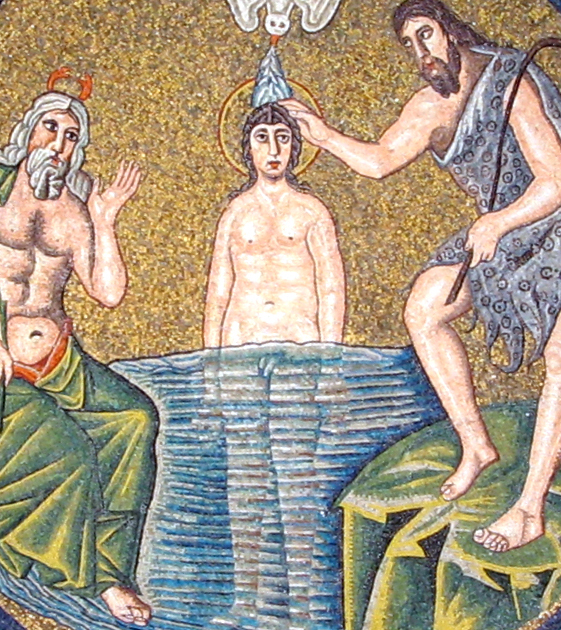
Now that I am done ranting about the uneducated problems of the world (seriously people, all it takes is a visit to wikipedia and a few youtube videos, I'm not even being pretentious here . . . at least not this time), I am switching gears to something with a much more joyous ring to it- the Sacraments. Since every New Life in the Church begins with Baptism, I thought it would only be appropriate to follow suit in this post. However, before I begin, I would like to comment on the picture above for two reasons: 1. dating back to 490 AD it is one of the oldest depictions of Christ and; 2. I love how humbling the physique of Christ (the less than muscular abs and arms, the slouched shoulders, that awkward looking phallic piece) is in this picture. It matches the humility that Christ puts on when he receives the Baptism in the Jordan from John. It's simply beautiful, even if it is from an Arian baptistery (sorry to burst your bubble, it hurt me too).
Where'd it come from?
As the beautiful, heretical mosaic suggests the sacrament finds its Christological support in the Baptism in the Jordan from St. John . . . the Baptist. However, it finds its sacramental support throughout the New Testament, beginning none more significant than the Baptisms which take place on Pentecost (Acts 2:41). The word derives from the Greek "Baptismos" (βαπτισμός), which refers to ritual washing in texts of Hellenistic Judaism in the Second Temple Period. It is also similar to "Tvila" (טְבִילָה), a Jewish (repeatable) purification ritual. Throughout the centuries, Baptism has been unquestionably the initiating sacrament of the Church. What has been up for debate almost from the beginning of Christianity- Tertullian (d. 220) even comments on it- is when to baptize. Some (Tertullian being one of them) have held that Baptism should not be administered until the baptized-to-be is an adult, so that they can conscientiously accept the responsibilities and consequences of their Baptism. However, given what Baptism accomplishes, infancy has become the normative, accepted age of Baptism for the Church.
What it does?
As members of the human race, we are descendants of Adam and Eve. Because of their sin, which was done in deliberate disobedience to God, all their descendants have a spiritual stain known as "Original Sin". Because God is the only one who can rid us of this sin, and He has already given us all that we have and are, we have no way of "earning" such a cleansing. Nonetheless, through the sacrament of Baptism, instituted by John the Baptist, favored by Christ, and performed by the Apostles and their descendants, we are blessed to be cleansed of this stain simply by cooperating with God's grace in our lives. As anyone can tell simply by experience, this does not wipe away all sin, or the potential to re-stain our spiritual garment (more on that later). However, in Baptism we die in Christ and rise anew, cleansed and made ready for full reception into the Church.
Obviously, I'm skipping over a lot of details of Church History and such, but that is the basic gist of it. As one of the not so few Catholics who consciously remembers their Baptism, the peace and the healing of that moment is perhaps the most lingering memory. Looking back on the various initiating processes of the various Protestant Churches (usually some event involving walking up to the altar), the one thing that I remember was how discombobulated it all was. I just went up to apologize to God and to reform my life, and before I could say "Forgive me Father", I was swarmed by pens and clipboards. But the piece and clarity of my baptismal experience is, I think, evidence enough of its efficacious reality in Christ.
God Bless,

What it does?
As members of the human race, we are descendants of Adam and Eve. Because of their sin, which was done in deliberate disobedience to God, all their descendants have a spiritual stain known as "Original Sin". Because God is the only one who can rid us of this sin, and He has already given us all that we have and are, we have no way of "earning" such a cleansing. Nonetheless, through the sacrament of Baptism, instituted by John the Baptist, favored by Christ, and performed by the Apostles and their descendants, we are blessed to be cleansed of this stain simply by cooperating with God's grace in our lives. As anyone can tell simply by experience, this does not wipe away all sin, or the potential to re-stain our spiritual garment (more on that later). However, in Baptism we die in Christ and rise anew, cleansed and made ready for full reception into the Church.
Obviously, I'm skipping over a lot of details of Church History and such, but that is the basic gist of it. As one of the not so few Catholics who consciously remembers their Baptism, the peace and the healing of that moment is perhaps the most lingering memory. Looking back on the various initiating processes of the various Protestant Churches (usually some event involving walking up to the altar), the one thing that I remember was how discombobulated it all was. I just went up to apologize to God and to reform my life, and before I could say "Forgive me Father", I was swarmed by pens and clipboards. But the piece and clarity of my baptismal experience is, I think, evidence enough of its efficacious reality in Christ.
God Bless,
שמואל
אוליבר יוסף קרלסון
(Samuel Oliver Joseph Carlson)

No comments:
Post a Comment