There are two quite biblical principles that we must address before we move forward. The first is that of Multiple Meanings, that is, that a text or scene takes on different meanings in different contexts. One biblical example is that of the Prophet Isaiah. In Chapter 7, we hear "the virgin shall bear a son, and shall name him Emmanuel" (Isaiah 7:14b). In its original context, the words of the prophet are a sign to Ahaz, that despite the threats from Israel and Syria, Judah will survive. The youth of the woman, the welcoming of new life, and the short lifetime of the two nations ("before the child learns to reject evil and choose good, the land of those two kings whom you dread shall be deserted") should be a sign of hope for Ahaz that Judah will endure.
However, when we find Isaiah 7 referenced in the New Testament, it takes on a different, albeit not dissimilar, meaning. Here, it refers to the miraculous birth of Christ by the virgin Mary. This child likewise represents new life and hope for the people of God, and their victory; however, this time it is not over another nation- but over sin and death. Just as the words of the prophet Isaiah take on different meanings which are not mutually exclusive, certain scenes in the Lion King, have a multivalent nature referring to aspects of the Old Testament (or Hebrew Bible) and the New Testament, as well as extra-Biblical Judeo-Christian traditions.
The second principle to be applied here is that of Atemporal Chronology. Both Old and New Testaments do not run as completely chronological texts, meant to be read from beginning to end, but rather they represent a composite of texts from the greater tradition. In the Torah, we find multiple traditions of the Semitic peoples gathered together into a single familial narrative. The most obvious example of this lies in the two creation narratives (to be mentioned later). Furthermore, in the aforementioned book of the prophet Isaiah, there are sections which in all likelihood are separated from hundreds of years from the prophet Isaiah. Not to mention the disparity between the representations of Hezekiah in Isaiah 36-39 and 2 Kings 18-20, or the identification of the Four Kingdoms in the Book of Daniel (the placement of the Medians pose particular problems).
The New Testament authors are likewise not legalistic in the chronology of their references. For instance, Jesus is a lawgiver like Moses ( Matthew 5-7) before he has freed his people on the Cross. He is the Son of David, and therefore a King, but is also referred to as the second coming of Elijah. Furthermore, there are the multiple chronological issues between the Gospels, including the infancy narratives, the routes of travel from Galilee to Jerusalem, and the all important chronology of the Paschal Mystery (in which the Synoptics and John differ). Not to mention the issues between the Pauline letters and the Acts of the Apostles. In overemphasizing the chronological consistency of Salvation History, we miss the accuracy of its symbolism and narrative expression. Likewise, the story of the Lion King may not precisely parallel the traditional outline of Salvation History, but this does not invalidate the richness of its theological reflection. With that being said, let's begin.
Creation to the Fall
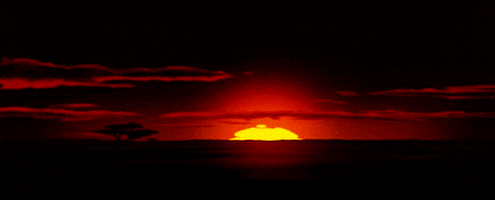
The film begins with a voice, primordially calling the light of the sun out of the dusk of twilight, not unlike the calling of God in Genesis 1:3. The scene continues as various species of animals and landscape are brought into the all encompassing light (Genesis 1:24-25). The waters, the birds of the air (Gen.1:20-23), crawling things, and every kind of wild animal (Gen 1:24-25), are seen before the audience realizes that these things themselves are not the ultimate telos of the scene. We begin to see them moving towards something, seemingly the pinnacle of all creation. We find here, the King Mufasa, a representation of God throughout the film (the fact that he is a Lion, the standard symbol for the tribe of Judah, should not go unnoticed), along with his prophet Rafiki, and his queen Sarabi. We see the son of God, made in his image and likeness (Gen. 1:27) the heir to the king of Glory. When this son is presented before creation, it bows in reverence before him, illustrating his dominion over all of the creation (Gen. 1:28). This is the fulfillment of the creation scene- mankind in God's image presented as the future steward of all of creation (Gen. 2:15).
In the next scene we find an indignant lion, named Scar (we shall say nothing here of his darker hue). He is clearly weaker than Mufasa, but is much stronger than the Adam-esque prince whose creation he did not attend. The reasons for his absence are made abundantly clear throughout the scene- prior to Simba's birth, he was the heir to the throne of Mufasa. Scar's absence, represents his protest of this new Adam, this new Son of God, and his desire to claim his so-called "rightful place" as heir.
This section might need a bit of background information, since the story is extra-biblical. There is a tradition concerning Michael the Archangel that in many ways parallels the power dynamics of this scene. In the extra-biblical narrative, God has gathered all the angels, archangels, and supreme beings for an announcement- that he will create the universe- that it will be spatial and temporal, and that there will be a sun and moon, rivers, earth, and sky, and creatures to inhabit the world. Furthermore, he says that one creature will not only be physical but spiritual, and that they will be beneath them, and they will serve them. Lucifer, before time the most beautiful and powerful of all the supernatural beings besides God, is outraged that he in all his "splendor" should be forced to serve creatures limited by the laws of nature and physics. It is at this moment, that Michael responds "Who Is Like God?" (the meaning of his name) and Lucifer and all his allies fall from heaven. In many ways, Scar parallels Lucifer in this scene, unhappy of his new rank in inheritance. Furthermore, throughout the scene, size and power are consistently referenced (the size of Scar's paw compare to the mouse, Scar's power over Zazu, "Why, if it isn't my big brother, descending from on high", "until the little hairball was born","that hairball is my son, and your future king", "when it comes to brute strength, I'm afraid I'm at the shallow end of the gene pool"). Scar's role as Lucifer, weaker than God, stronger than humanity, is clearly established.

The final question of this section surrounds motivation: Why does Simba go to the Elephant Graveyard? Is it comparable to Adam & Eve's partaking of the Fruit? We find our answer for both in the song prior to the Elephant Graveyard scene, "I Just Can't Wait to Be King". Simba, in seeing his future destiny desires more than to be made in the image of the King, but now seeks to become the King himself (Gen. 3:4). Even afterwards we hear him say "I wanted to be brave, like you". The primary issue is that Simba sees his future kingship as "something to be grasped at" as oppose to emptying himself in humility to the circle of life. Mufasa's mentioning of his own death, and the place of the Kings among the stars, is a reminder of this circle of life, and the reality that Simba is dust, and unto dust he shall return (Gen 2:17).
Death and Exile
Despite Mufasa's victory over Scar's minions, the hyenas, Scar seems to have a certain confidence that he has won a victory of his own. Simba's disobedience seems to have changed the paradigm for Scar. It was only several minutes ago, Scar says "I wouldn't dream of challenging you", but now we find him singing "Be Prepared", for he will kill not only Mufasa, but his son as well. The disobedience of the Son has now brought death into their world (Romans 5:12). It is noteworthy here that the symbolism of fire and brimstone is quite present in this scene. It is a party of the fallen, a party for the damned, for they now seemingly have the upperhand, in a way they did not have before. They now have claims over the circle of life (Rom. 5:17).
 It should not be taken for granted that the scene which most clearly parallels the Crucifixion directly follows that scene which clearly parallels the Fall of Adam. All the more, Simba's movement from off his rock is driven by his desire to master his roar, to show domination over a chameleon, to grasp at his future kingship before it has come. It is in this fallen state (it is no accident that he is in a gorge below ground level, with little life present), that he sees the descent of the wildebeest. Simba finds himself overwhelmed by the multitude, the size and the speed of the wildebeest, and he is quite clearly unable to save himself- just as humanity is overwhelmed by sin (Psalm 38:4), unable to save itself from the surety of death which sin brings.
Mufasa, in his love for Simba (John 3:16, 1 John 4:10, Romans 5:8), enters into the gorge, enters into the depths of Simba's experience, to save him from his sins, embodied by the wildebeests. He is successful in saving his son, and almost himself, until he is killed by his brother, Scar as he says "Long live the King", which is very reminiscent of the irony found in the label of INRI (translated "Jesus of Nazareth, King of the Jews") found on the cross. Scar finds his victory, Death finds its sting, for they have conquered the seemingly unconquerable, they have killed the king (Matthew 27:54), they have killed the Father.
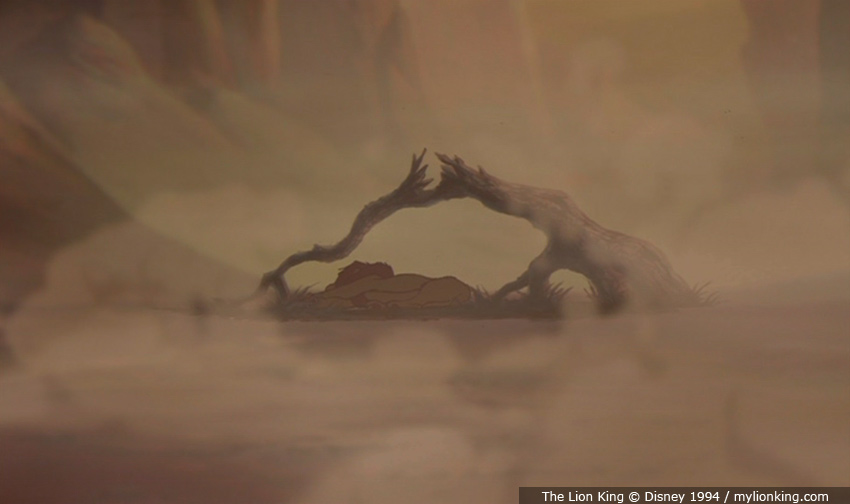
It is not by accident that we find the deceased Mufasa framed by a tree- a common symbol for the Cross in both the New Testament and the early Church- barren and broken in half. The symbolic connection is quite transparent, and it is why I find this portrayal to be a particularly useful one for understanding the Crucifixion, and more particularly the Atonement theory. Our common understanding concerning the Atonement theory comes primarily from St. Anselm of Canterbury who died some 900 years ago, although there are clear elements of this train of thought prior to Anselm, and even present in various Biblical texts. St. Anselm explicitly and clearly lays out that "Jesus died for my sins" means that our sin put us into debt with death, and God sacrifices Jesus in our place, thus freeing us for life with God.

The common objection is that God in this paradigm appears brutish and barbaric (I have my own objections to this counter, but I will leave them aside here), demanding the death of either his son or his creation- "If God is all knowing, all good, and all powerful, why couldn't he just solve it without the brutality of sacrificing one's son?" The Lion King illustrates a crucifixion scene which emphasizes the oneness of God- the sacrifice of God for his children (us) rather than the sacrifice of his child (Jesus). Jesus is the Son of God, but he is also one with God. His incarnation is God sending God's self into humanity Matthew 1:23), his crucifixion is God sacrificing God's self for his people. In the atonement theory, the Father is not the recipient of the debt paid, he is the one who pays it off.
After this, Simba manages to escape to the wilderness where a voice cries out (Mark 1:3), off screen, to scare off the vultures of death from this fatherless son's life, whose debt has been paid. This in many ways can foreshadow the result of the final encounter with Scar- Death has no more power to slay. Simba encounters Timon and Pumbaa and learns through melody of song, there ways of life and their carefree nature. As Simba grows older, he begins to grow quite comfortably into this new way of living and he becomes a member of their newly formed three amigos/musketeers/stooges.
I should be clear, this scene is challenging in terms of its theological significance, and it would be easy (very easy) to write this scene off as merely lightening the mood after the death of Mufasa, or a commercial plug of two goofy kid-friendly characters (which Disney has taken ample opportunity to market considering their actual significance in the movie). Nevertheless, there are certain theological elements that can be taken away from this moment. The first is the tradition of the Wilderness. Jesus is tempted in the desert (Matthew 4:1-17; Mark 1:12-13; Luke 4:1-13; ), and emerges with (presumably) a deeper sense of identity and vocation. John the Baptist comes out of the wilderness to begin his ministry of baptism (Mt. 3:3; Mk. 1:3; Lk. 3:4; John 1:23). Much of the tradition of vocation, comes after a person's circumstance of isolation from the rest of society for an extended period of time. However, despite this tradition, little is actually mentioned of these moments of isolation. For Jesus, there is a great deal of time spent on the three temptations of Satan, but nothing is mentioned of the Forty days prior. We hear about the life of John the Baptist, and his diet certainly resembles Timon and Pumbaa's (Mt. 3:4; Mk. 1:6), but little about what he learned, what he encountered while he was in the wilderness.
The most well outlined biblical tradition of Wilderness is that of the Exodus. While most popular
 portrayals of the Moses narrative end with the parting of the Red Sea, in the 40 chaptered book of Exodus, the scene at the Red Sea is over by chapter 16- not even half way through the book. The rest of the text illustrates Israels bristling at the responsibility of freedom and independence. The manna in the wilderness, provides little long term satisfaction (Exodus 16:20)- just as the "slimy yet satisfying" food of Timon and Pumbaa does not satisfy Simba's hunger for an antelope or a zebra.
Despite his familiarity, Simba finds himself lost in this new context unsure of his beliefs (Psalm 137:4-6). We forget that in the Exodus, the people themselves never saw God, never heard his voice- they only hear the accounts of Moses. Are they to let go of their livelihood in Egypt, and the comforts and customs which their fathers and forefathers shared (Exodus 32:1)? The scene of Simba, Timon and Pumbaa under the stars is indicative of this feeling. In sharing their beliefs, Timon and Pumbaa present their beliefs which illustrate a very basic, descriptive understanding (the stars indeed are balls of gas, and from our perspective very much look like fireflies), Simba presents a rather sophisticated symbology which does not seek merely to describe what the stars are, but why the stars are their and explains not only their appearance but the comfort they bring to those who set their eyes upon them. This is altogether unintelligible to his companions (Psalm 137:1-3) and what he once saw as unencumbered truth, begins to fall apart when criticized. We may not see hear the creation of the golden calf (Exodus 32:4), but we can begin to understand the temptation towards it.
Remembrance
While going off to look for food, Nala finds Simba miraculously alive. Like May Magdalene before
her (John 20:16), Nala is the first to encounter the seemingly resurrected Son ("it's like your back from the dead"). I should briefly add, for those who would wish to deepen the parallels of Mary Magdalene's relationship to Jesus to Simba and Nala, that up until this point Simba and Nala have been nothing more than
 friends, and even flatly reject the possibility of becoming lovers when they last spoke on the subject. The love affair between Simba and Nala more accurately reflects the relationship between Moses and Zipporah. Moses' marriage to Zipporah (Exodus 2:21) directly precedes his encounter with angel of the Lord in the burning bush (Exodus 3:2). Just as Moses' marriage to Zipporah reminds him of the suffering of his people (Exodus 2:24), Nala serves as a reminder to Simba of what he has left behind. Simba, like Moses and later like Israel, has grown comfortable in the wilderness (Numbers 14:2-4) and in the comfort of his state of being lost, he doubts his own ability, just as Moses doubts his ability (Exodus 4:10) and just as Israel doubts their ability (the aforementioned passage in Numbers). All three doubts (Simba, Moses, and Israel), reflect a larger doubt about the ability of God- "you said you'd always be there for me, but your not".
It is in this moment that the prophet Rafiki appears in one of the most theologically rich scenes in
cinematic history: "Can't cut it out, it'd grow right back"/"if they kept quiet, the stones will cry out" in Luke 19:40; Our view of Rafiki's "Who are you?" question in the first person; "Come here its a secret"/The theme of the Messianic Secret of the Gospel of Mark- and those are just the elements which I am not going to talk about). Like the Biblical Prophets, Rafiki poetic method of speech initially appears as a symptom of insanity (2 Chronicles 36:16; Mt. 5:11-12; Lk. 6:22-23), but quickly becomes an apparent sign of his great wisdom. At first Rafiki's utter joy in the midst of the wandering of Simba seems bizarre and non-sensical, but it becomes clear once we understand that he knows what Simba does not- his own identity. He acknowledges Simba's place, lost in the wilderness, to prove that his joy is quite clear, and well understood: "I'm not the one who is confused, you don't even know who you are!" The prophets are likewise ridiculed for their counter-intuitive understanding of the truth. However, in revealing to Simba his own forgotten identity
Rafiki's knowledge goes even deeper, as is exemplified in the brief dialogue with Simba listed below:
 Simba:"You knew my father?"
Rafiki:"Correction, I know your father."
Simba:"I hate to tell you this, but he died a long time ago"
Rafiki: "Nope! Wrong again! He's alive and I'll show him to you. You follow old Rafiki he knows the way"
Rafiki clearly has access to a knowledge unbeknownst to Simba, but something he has longed for, a longing which he knows deep down is grounded in some level of truth. Rafiki affirms to Simba this truth which he has always known, but has lost his ability to understand and explain. Rafiki, in being the prophet of God, has retained this knowledge and in his role of prophet, serves as a reminder to Simba of his true and ultimate calling.
The scene continues as Rafiki drives Simba through a periculous journey to this calling, to the truth which Simba has longed for since his exile as a youth. When they reach his destination, Simba is disappointed that he is only brought to his reflection. However, after stirring the waters of the pool, Simba's blindness begins to fall away (John 5:3-4), and he sees this vocation that God has called him to- "You see,
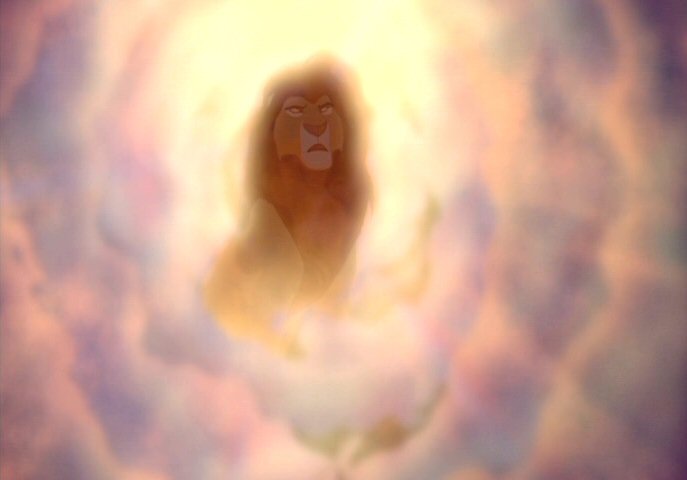 he lives in you." Simba's despair over his Father's death is grounded in his own inability to live out the life to which his father called him. Immediately after seeing his father in his own reflection his father appears, in his glorified state, among the clouds, and consistently calls his son to "Remember".The issue of Memory looms large for Israel's experience in the wilderness. The Lord is consistently referred to as the God of "Abraham, Isaac, and Jacob" (Exodus 3:6), calling Israel to remember that their devotion to God is rooted in the devotion of their forefathers. The Law is given as a consistent reminder of how Israel is called to live in accordance with the will of God (Deuteronomy 6:4-9, the latter half of which serving as a consistent reminder for the people of God). God is consistently frustrated with his people's inability to remember who brought them out of Egypt (Deuteronomy 5:15) with 10 plagues, the parting of the sea, and pillars of cloud and fire. Even prior to the actual fleeing from Egypt, the Passover meal is instituted as a remembrance of the exodus from Egypt (Exodus 12:14, 13:3). The theme of memory of the exodus is not merely a symbolic gesture, but it is a remembrance which creates a reality. In remembering the Law, the Passover, the Exodus, Israel embodies what it means to be "People of God" and create a world which becomes God's Kingdom. It is this way of memory, that Mufasa calls Simba to "remember"- he must return and live out his calling as King.
Redemption
We enter the scene at Pride Rock in a seemingly Eschatological state. The land once celebrated as a pinnacle of creation is now a barren wasteland as Scar, death's embodiment, reigns supreme. The enmity between him and Sarabi (Gen. 3:15), Simba's mother is readily apparent from the moment we see them both. When Scar strikes her, as if to wage war against her (Revelation 12:17), we see her offspring- Simba embark onto the scene. At first, she "mistakes" Simba for Mufasa, and Simba represents the Resurrection yet again (perhaps a reference to the 2nd coming). When he encounters Scar, and admonishes him that his reign as ruler is

It is as Simba is driven to the edge of defeat on account of his own sinfulness, that the flames we last saw as the underworld celebrated its victory. To Scar, they may serve as a reminder to his victory in driving Simba to disobedience, but they also serve as the environment of the revelation that the sin resulting in the death of Mufasa, is not the fault Simba, but that of Scar- the deceiver. In recognizing the truth of his own lack of culpability, Simba gains new strength and begins to not only look like the Father, but act like him. What follows is the great final battle between the sons of light (or daughters- as they are lionesses) and the sons of darkness (the hyenas)- a common trope of the Dead Sea Scrolls. Simba and Scar exchange blows, until Simba falls, and when Scar lunges at him, Simba propels him over the edge (Rev. 20:10) he just minutes earlier was hanging from. Scar tries to appeal to the mercy of his hyenas, but he has not trained them in mercy. At the end he is consumed by his own ambition, his own pride, his own hatred (just as in Dante's Inferno, the impressive flapping of Satan's wings continues to further freeze the ice in which he is stuck).
 At the defeat of Scar, the skies open up, and the rains of new life, cleansing and Baptism descend upon the land. They wash away the flames of destruction and death, and initiate the return of life to Pride Rock. The Lions, along with their allies in battle, somberly celebrate their victory, and it is made clear that it is time for Simba to ascend to his new place as King. After giving thanks to his mother and Nala, he ascends to his throne (Rev. 4:2-3), likewise thanking his prophet Rafiki. It is in this ascent that we see quite strangely a skull washed away from the foot of pride rock. We may remember that the hill on which Christ was Crucified was called Golgotha, which means "the place of the skull" (Mt. 27:33; Mk. 15:22; Lk. 23:33; Jn. 19:17), but the text itself does not provide an explanation for this aside. Why is it called the skull? Tradition tells us that this hill is where Adam, the first human being and source of sin, was buried and it is to his skull (i.e. the remains of his body) that the hill receives its name. In this way, the Gospels establish a paralellism in which Sin and Death is defeated on the very hill on which it began through the death of its first victim. Thus, the place of the skull in this scene references the likewise conquering of death embodied in the ascending King.
Conclusion
In today's Christianity, we are in many ways recovering from the historicization of the Biblical test, and trying again how to understand it as a document of faith. Many scholars are calling, not for a Biblical literalism, or historical criticism, but a "Biblical Imagination" by trying to understand the world which created the Scripture, and the world that is created by Scripture. The Lion King certainly does not present the former, but it is an imaginative expression of the latter. it adopts the story of Judeo-Chrsitianity, and places it in a new context with new characters that nevertheless incarnates the same message- the conquering of love and creation over death and destruction. In reflecting on this reality, I hope I have helped you, the reader, see the Lion King in a new way, but moreso I hope that you can see the Gospel in a way which calls you to remember your own duty as made in the image and likeness of God.

No comments:
Post a Comment